
What You Will Learn
- How a Smith machine differs from a squat rack or power cage
- Steel, hole spacing, safety, and footprint questions to copy
- When a half squat rack is the honest SKU
- Photo checks before you pay a deposit
Table of Contents
Smith machine vs squat rack, as a wholesale question
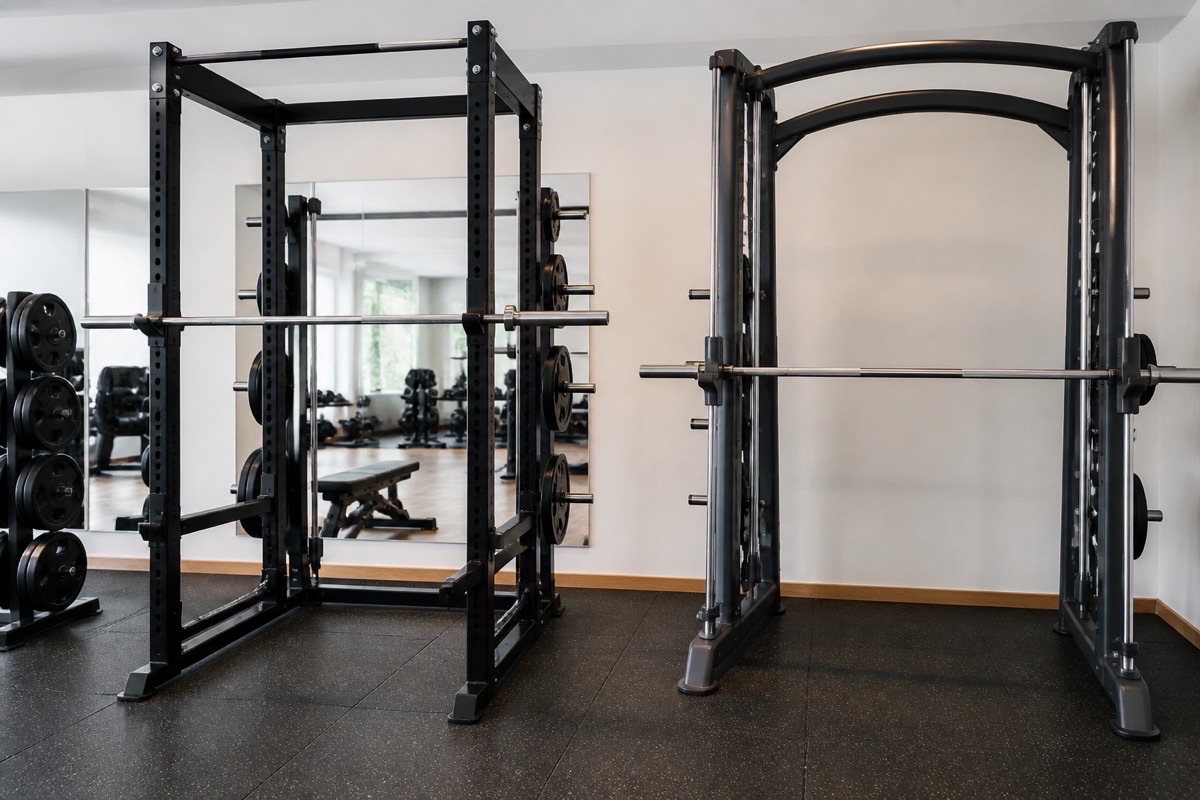
A squat rack (including many squat rack power cage designs) holds a free barbell on J-cups or supports so the lifter moves the bar in free space; a Smith machine guides the bar on fixed rails. Smith machine vs squat rack is therefore a programming and footprint decision before it is a paint color on a spec sheet.
Yunlingyu lists squat racks, Smith machines, and benches among factory capabilities for wholesale buyers. Matching bars still come from the free-weight line—for example a steel power bar. This article is the list of spec-sheet questions to send before you compare quotes. It does not invent a SKU URL that is not on the current product register.
Quotes that only list “cage” or “Smith”
Two squat racks can differ in upright steel size, hole spacing, pull-up bar type, and whether safety arms are included. A Smith machine can differ in bar weight, linear-bearing quality, lock spacing, and whether the counterbalance is honest. Power rack vs squat rack is another split: a power cage usually has four uprights and a fuller safety system; a half squat rack or two-post rack is smaller and needs a smarter spotter plan.
Spec questions to copy into the RFQ
| Topic | Ask | Why it matters |
|---|---|---|
| Steel | Upright tube size and wall thickness | Flex and advertised load |
| Holes | Spacing (mm) and hole diameter | J-cup and safety compatibility |
| Footprint | Width, depth, height; ceiling clearance | Shipping and room layout |
| Safeties | Arms, straps, or spotter bars included? | True working load for a gym |
| Bar path (Smith) | Angle, lock spacing, stated bar weight | Member feel and programming |
| Finish | Powder coat, hardware grade | Chip rate in commercial use |
| Packing | Carton count, hardware bags, assembly guide language | Install time on site |
| Bar pairing | Olympic sleeve; whose bar is included | Avoid a 1-inch bar in a commercial cage |
If the quote is a “smith machine squat rack” combo unit, demand a photo of both the rail system and the free-bar J-cups, plus two weight ratings. Combo photos hide missing safeties. A half squat rack needs the same hole and safety questions as a full cage, plus a note on whether it bolts to the floor.
Hole spacing is how you mix attachments later. If you might add cable kits, dip bars, or a landmine, ask whether the upright pattern is a common commercial spacing or a factory-unique pattern. Unique patterns lock you into one spare-parts channel. J-cups should be photographed on the upright at a typical squat height and a typical bench height. A rack that cannot hold a bench press position is not a squat rack and bench solution even if the powder color matches.
Load ratings on marketing sheets are not a substitute for steel size. Ask for upright outer size and wall thickness in millimeters, and for whether the rating is for the whole cage or for a single J-cup. Smith machines need a separate conversation: rail smoothness, lock-hook spacing, and the stated bar weight (often not 20 kg). If the Smith bar is permanently captive, you still need a free Olympic bar for the squat rack side of a combo unit. Hardware packing lists in English save install days; bags labeled only in Chinese slow hotel and school jobs.
Shipping cube for racks is long cartons plus a hardware box. Confirm carton count and whether the unit is fully knocked down. A “assembled photo” in the catalog does not mean it ships welded. Ceiling height at the destination gym belongs on the RFQ: a 2200 mm cage in a 2300 mm room is a failed install. Half squat racks and wall-fold designs exist for that problem; they are not the same RFQ as a full power cage. Put room height, door width, and whether a forklift can enter the gym on the same email as steel size.
How to choose without duplicating every station
- Free-bar strength floor: squat racks or a power cage, Olympic bars, plates from the plate RFQ.
- Guided bar for general population or hotel gyms: Smith machine, still with safeties you can explain to staff.
- Small rooms: half squat rack plus a bench, not a full cage that will not fit the ceiling.
- Do not skip benches—many programs need a squat rack and bench pair; confirm bench height vs J-cup range.
Plate and dumbbell fill still matter after the rack is chosen. Commercial hex dumbbells and bumper plates are separate lines; see hex rubber dumbbells and Olympic barbell specs. Factory capability checks: vetting checklist.
What not to assume
Do not assume a Smith bar is 20 kg. Do not assume J-cups from brand A fit brand B holes. Do not order racks without a hardware packing list in English if your installers do not read Chinese. Do not treat “home gym squat rack” search photos as commercial steel.
FAQ
Is a power rack always better than a squat rack?
A power cage usually offers more safety positions and pull-up options. A two-post squat rack can be enough if footprint and budget are tight and spotting is planned. “Better” is the room, not the catalog name. A cage that cannot fit through the stairwell is not better.
Can I use one Olympic bar on both Smith and rack?
The Smith bar is usually dedicated to the rails. Buy a separate Olympic bar for the squat rack. If the combo unit includes a captive Smith bar, still line-item a free bar for squats and bench work.
What photos should the factory send before I pay a deposit?
Upright close-up, hole spacing with a ruler, safety arms installed, weld examples, and the packed carton list. Add a photo of the J-cup teeth and of the pull-up bar diameter if members will hang from it daily. Blurry assembled lifestyle photos are not that set.
Do I need floor anchors?
Ask. Many commercial half racks and some Smith units specify anchors. Put that in the install guide request. Also ask whether the destination floor is concrete, rubber over concrete, or a raised wood platform—anchor hardware differs.
RFQ paragraph you can paste: room height, door width, Smith vs squat rack vs power cage (pick one primary), whether a bench is included, Olympic bar yes/no, safety arms included yes/no, upright size in mm, hole spacing in mm, carton count, English hardware list. Yunlingyu can discuss rack and bench programs against that paragraph. A quote that only says “Smith machine squat rack, cheap, powder coat black” is not comparable to a quote that answers those fields.
Conclusion
A wholesale smith machine vs squat rack decision is steel size, hole spacing, safeties, footprint, and whether the bar is free or railed. Copy the table into your RFQ. Yunlingyu can discuss rack and bench programs together with bars and free weights via contact-us.
Comparing a Smith machine vs squat rack quote?
Paste the spec table into your message with room height and whether you need a bench. Yunlingyu will reply against those fields.
About the Author
This guide is brought to you by Yunlingyu (Dingzhou Yunlingyu Sports Goods Co., Ltd.), a fitness equipment manufacturer specializing in dumbbells, weight plates, barbells, squat racks, Smith machines, benches, kettlebells, and related gym products for wholesale, OEM, and private-label buyers worldwide.

